
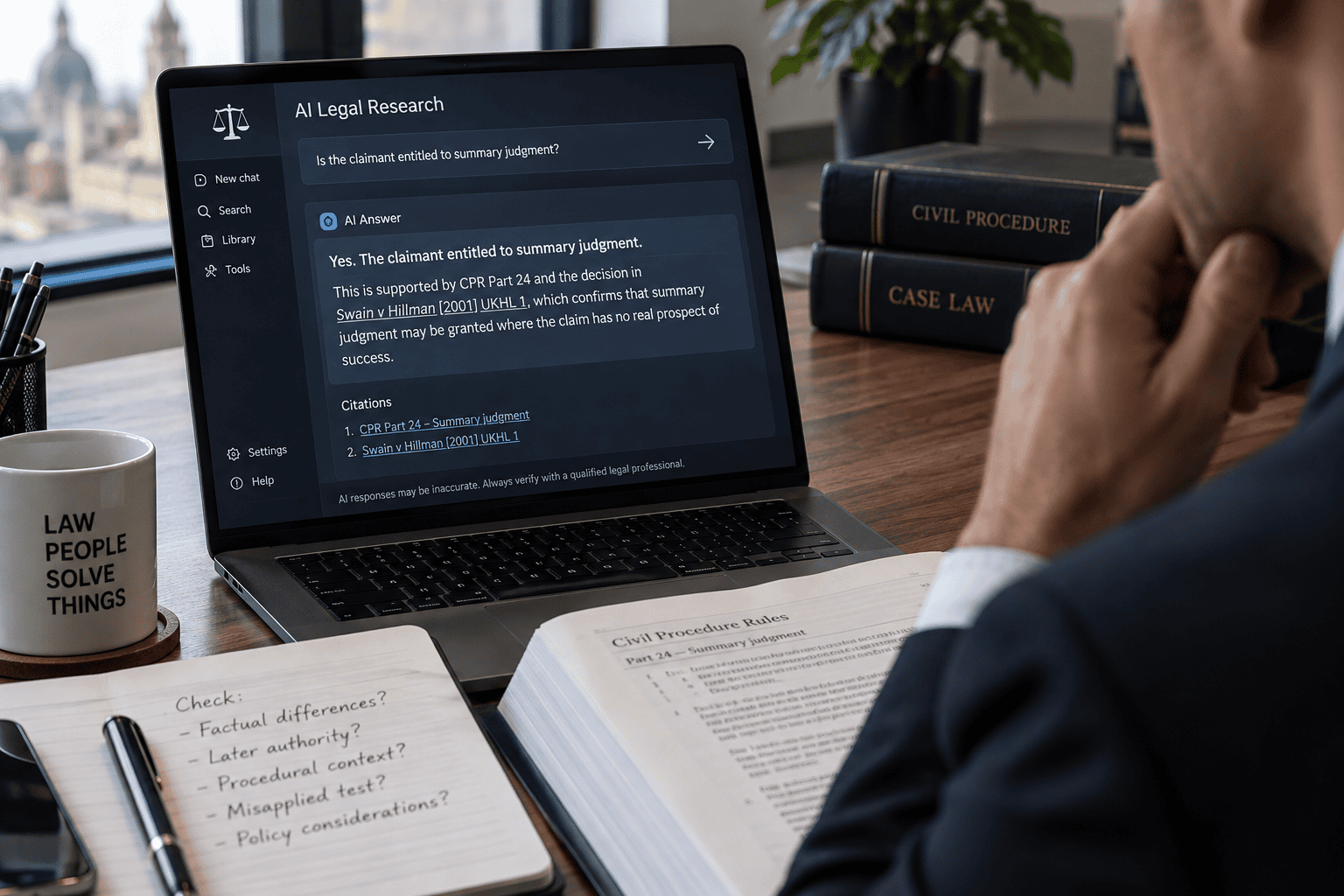
The law still needs to be reviewed by a lawyer.
Anyone following the story of artificial intelligence in the courts knows about the fake cases. A citation looks entirely plausible — right-sounding parties, a neat neutral citation, a tidy summary — and it simply does not exist. In R (Ayinde) v London Borough of Haringey, heard with Al-Haroun v Qatar National Bank QPSC, a Divisional Court presided over by the President of the King’s Bench Division dealt with exactly that, referred the lawyers involved to their regulators, and made the position plain: anyone using AI for legal research has a professional duty to check what it produces against authoritative sources — and that duty applies equally to someone relying on research another person has done with AI.
Hallucinated citations, though, are the easy problem. They are embarrassing and career-limiting, but they are also findable: you look the case up, and it is not there.
The harder problem — the one that costs businesses money quietly, without anyone being named in a judgment — is the answer built on real law that is still wrong.
Real authority, wrong conclusion
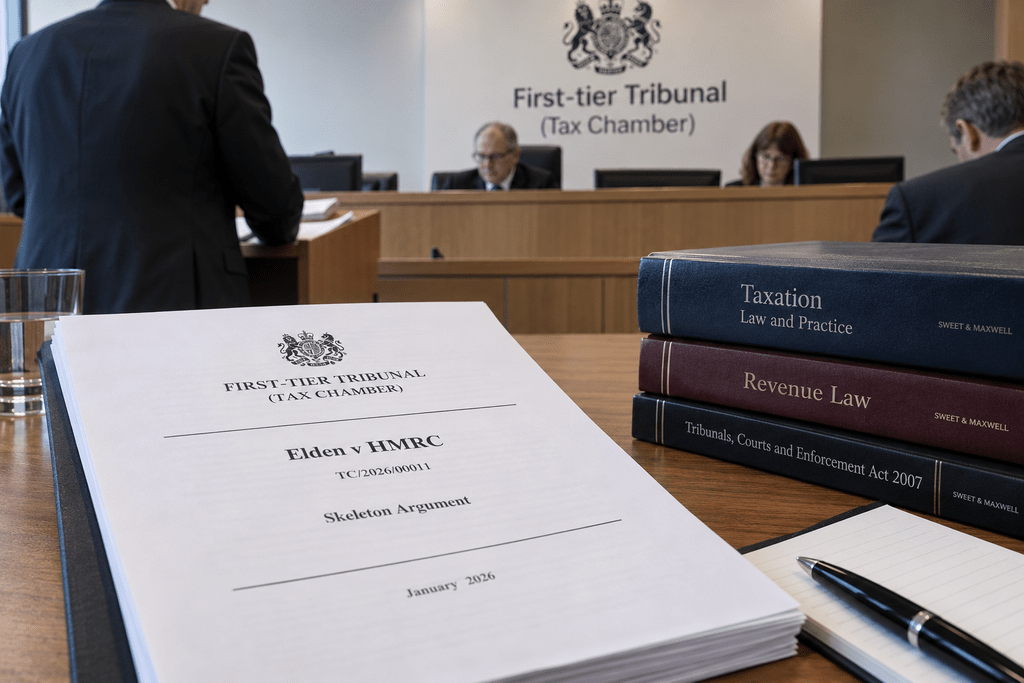
In January 2026, the First-tier Tribunal considered a skeleton argument in Elden v HMRC in which the cases cited were genuine but the summaries of them did not accurately reflect what those cases actually said. The Tribunal was not hostile to AI as such; its concern was that adequate accuracy checks had not been made, which cast doubt on the reliability of the whole document. It declined to strike the appeal out, but directed that any replacement skeleton argument be supported by full copies of the judgments, direct quotations with paragraph references, and a statement of truth confirming who had personally produced and checked each part.
That is the failure mode worth understanding, because it is far more common than invention. A few of the ways it happens:
The law is real but no longer says that. Provisions are amended, repealed and replaced; commencement is staggered; transitional provisions mean the old rule still governs older facts. A tool trained on a corpus of text has no reliable sense of what is in force today, for these facts, in this jurisdiction.
The case is real but does not support the proposition. A sentence lifted from a first-instance judgment can read like a rule when it was obiter, conceded, confined to unusual facts, or subsequently distinguished or overruled on appeal. Precedent is a hierarchy, not a search index.
The authority is from somewhere else. English, Scottish, Northern Irish, US and Commonwealth material sits side by side in the same training data. A confidently stated proposition of “employment law” or “contract law” may be perfectly accurate — in Ontario.
The general rule arrives without its exceptions. Most commercially important questions in England and Wales turn on the carve-outs: the qualifying period, the limitation date and whether anything stops the clock, the statutory exception, the small-print condition precedent. A summary that gets the general rule right and omits the exception is not partially correct; for a client relying on it, it is simply wrong.
Your contract displaces the default. Much of commercial law is a set of defaults the parties are free to vary. An answer about “the position on termination” or “the notice you must give” is worthless unless it has been read against the clause actually in your agreement — and a tool that has not seen the agreement cannot do that.
The question itself was the wrong one. This is the deepest limitation. Clients ask the question they think they have; much of what a solicitor does is work out what the question really is — whether the dispute is contractual or statutory, whether there is a limitation problem nobody has spotted, whether the real exposure sits in a director’s personal guarantee, whether the better move is a claim or a settlement. AI answers the question you asked. It will not tell you that you asked the wrong one.
To this you can add what never appears in a research answer at all: procedure and forum, what you can actually prove, without prejudice protection, costs risk, regulatory notification duties, and the commercial judgement of whether a right worth having is a right worth enforcing.
Fluency is not reliability
All of this is easy to miss because these tools are very good at producing text that reads like competent legal analysis. The register is right, the structure is right, and the confidence is uniform — uniform whether the underlying reasoning is sound or unsound. There is no visible difference between an answer that is correct and one that is subtly, expensively wrong. That is precisely why a human check is not an optional extra.
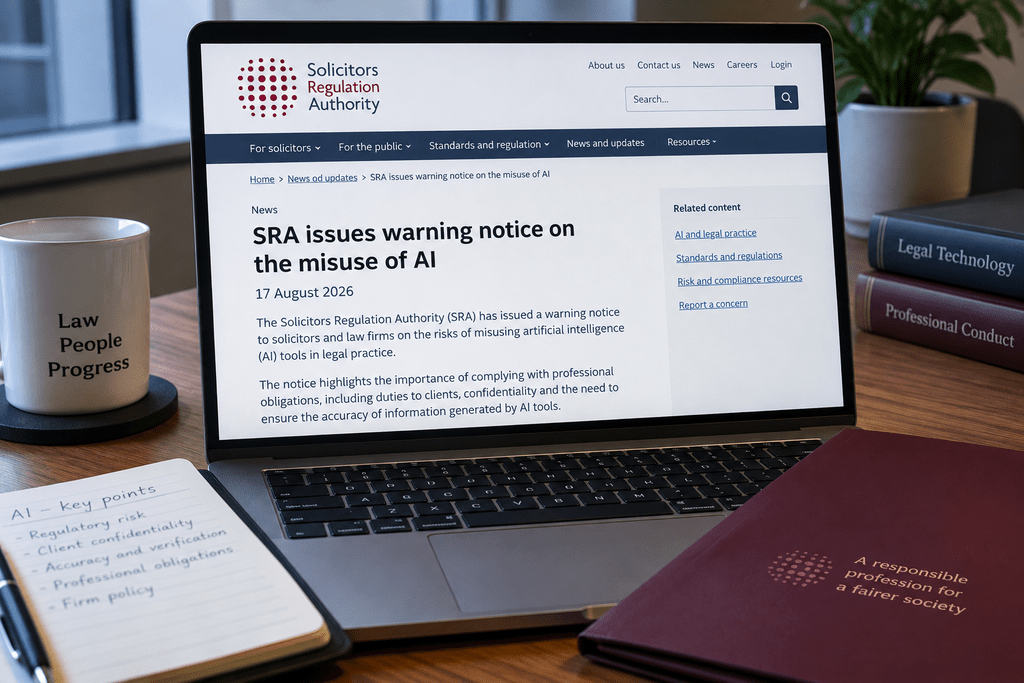
Regulators and the courts have reached the same conclusion. The Solicitors Regulation Authority issued a warning notice on the misuse of AI on 17 August 2026, having received 42 reports of potential misuse in the year to July 2026, covering inaccurate citations, supervision failures and confidentiality breaches. Its position is that solicitors must verify the content of legal submissions and remain personally responsible for accuracy whatever tools were used — reliance on an AI output is not a defence. The judiciary’s guidance for judicial office holders, refreshed in October 2025, takes the same line on hallucinations and on personal responsibility for material produced in one’s name.
What this means if you are not a lawyer
If you are running a business, or sitting in an in-house role without capacity to cover everything, the temptation is obvious. The research is instant and articulate, and it looks like the thing you would otherwise pay for.
The difference is what sits behind the answer. When a regulated solicitor in England and Wales advises you, you are dealing with someone professionally accountable for that advice, who is required to carry professional indemnity insurance on minimum terms; legal advice privilege will generally attach to the advice; and if something goes wrong you can raise it with the firm and then, subject to the eligibility criteria and time limits, with the Legal Ombudsman, or report conduct concerns to the SRA. An AI output will not normally carry any of that.
Confidentiality is a live issue too. No English court has yet decided definitively whether material you generate in a commercial AI tool attracts privilege, although the Upper Tribunal has observed in passing that uploading confidential documents into an open tool put the information into the public domain and waived privilege, and a US federal court declined to protect such material in February 2026. The safe working assumption is that your prompts and outputs may be disclosable, and are not confidential in the way a conversation with your solicitor is.
None of which is an argument against using AI. Used well, it is a useful orientation tool: it will help you frame a question, understand unfamiliar terminology, and arrive at a conversation with your solicitor better informed and therefore more cheaply advised. The sensible discipline is to treat its output as a hypothesis rather than an answer — check every citation exists and says what it is said to say, confirm the law is current and is the law of England and Wales, read it against your own contract, and have anything you intend to rely on, sign, send or file reviewed by a qualified lawyer.
The right law is a starting point. Applying it to your facts, in this jurisdiction, as it stands today, with the exceptions and the commercial consequences attached, is the actual work.
If you have used an AI tool to research a legal question and want the answer checked before you act on it — or you would prefer to start with advice you can rely on — the team at 360 Law Group would be glad to help. Please get in touch to discuss your situation.
This article is general information about the law of England and Wales as at August 2026. It is not legal advice and should not be relied upon as such. You should take advice on your own circumstances before acting.