

Few fast-growing businesses fail because of a badly drafted clause. But plenty have lost money, momentum or leverage because of one.
Contracts are the connective tissue of a scaling company. They set out what you owe your customers, what your suppliers owe you, who owns the code your developers wrote and what happens when a relationship sours. Get them broadly right and they recede into the background. Get them wrong and they tend to resurface at precisely the moment you can least afford the distraction, during a funding round, an acquisition, or an argument with your largest client.
The mistakes below are the ones we see most consistently among startups and scale-ups operating under the law of England and Wales. None of them are exotic. All of them are avoidable.
1. Trading before anything is signed
English law does not require most commercial contracts to be in writing, which is a mixed blessing. It means a binding agreement can arise from a chain of emails, a purchase order and a delivery, long before anyone signs the “real” document. In RTS Flexible Systems v Müller the Supreme Court found the parties had contracted through their conduct despite a formal agreement never being executed.
The practical risk is not that you have no contract; it is that you have one you never chose. Where work has begun and terms remain open, the party with the better paper trail usually prevails.
The habit that prevents it: mark negotiation documents “subject to contract” and mean it. If commercial pressure requires an early start, use a short letter of intent or interim services agreement that fixes price, scope, IP ownership and liability, and expressly states what happens if the full agreement is never signed.

2. Losing the battle of the forms
Your customer sends a purchase order incorporating their standard terms. You acknowledge it with an invoice incorporating yours. Both sets are perfectly drafted and mutually contradictory. Whose apply?
The courts approach this through conventional offer-and-acceptance analysis, so the answer often turns on who fired the “last shot” before performance began, though as Tekdata v Amphenol confirms, the documents and conduct as a whole can displace that. What it rarely produces is the outcome either party assumed.
The habit that prevents it: decide who owns the paper in each relationship and be deliberate about it. Where you are the supplier, make acceptance expressly conditional on your terms and train the people issuing acknowledgements. Where the value justifies it, negotiate a single signed framework agreement and stop exchanging competing boilerplate altogether.
3. Borrowed terms that were never yours
Standard terms copied from a competitor’s website, a template bought online or the last company a founder worked at are the single most common source of contractual mismatch we encounter. They usually describe a different business model, a different risk appetite and occasionally a different jurisdiction.
The consequences are quietly expensive: a services business whose terms are drafted for the sale of goods, a SaaS provider promising uptime it has no supplier-side commitment to deliver, or a company purporting to exclude liability in terms the law will not enforce. Borrowed terms may also carry someone else’s copyright.
The habit that prevents it: treat your terms as a description of how you actually operate. If your delivery model, pricing or supply chain has changed materially since the terms were written, they need revisiting.
4. Liability clauses that will not survive scrutiny
Limitation and exclusion clauses are where optimism most often outruns enforceability. Under the Unfair Contract Terms Act 1977, where you deal on written standard terms of business, clauses excluding or restricting liability for breach are subject to a reasonableness test. Liability for death or personal injury caused by negligence cannot be excluded at all, and no clause will protect a party against its own fraud.
Equally common is the mistake in the other direction: uncapped liability, or a cap set at a figure the business could not absorb and does not insure. Liquidated damages provisions are a related trap – a sum that is out of all proportion to the legitimate interest being protected risks being struck down as a penalty, following the Supreme Court’s reformulation of the rule in Cavendish Square v Makdessi.
The habit that prevents it: cap liability at a figure you can articulate a commercial rationale for, align it with your insurance cover, exclude indirect and consequential loss in clear language, and carve out the categories the law will not let you touch.
5. Not owning the intellectual property you think you own
This is the issue most likely to stall an investment or a sale. Where an employee creates a copyright work in the course of employment, the employer is generally the first owner. Where a contractor, agency or freelancer creates it, they are, unless there is a written
assignment signed by them. An implied licence to use the work may arise, but a licence is not ownership, and an investor’s due diligence will say so.
The habit that prevents it: put a written IP assignment in every contractor, consultant and agency engagement, signed before work begins, and audit historic engagements now rather than under time pressure later. Founders’ pre-incorporation work needs assigning to the company too.
6. Treating payment terms as an afterthought
Cash flow kills more small businesses than litigation does. The Late Payment of Commercial Debts (Interest) Act 1998 already gives suppliers a statutory entitlement to interest at eight per cent above the Bank of England base rate, plus a fixed sum in compensation, where no substantial contractual remedy is provided, a right most SMEs never invoke.
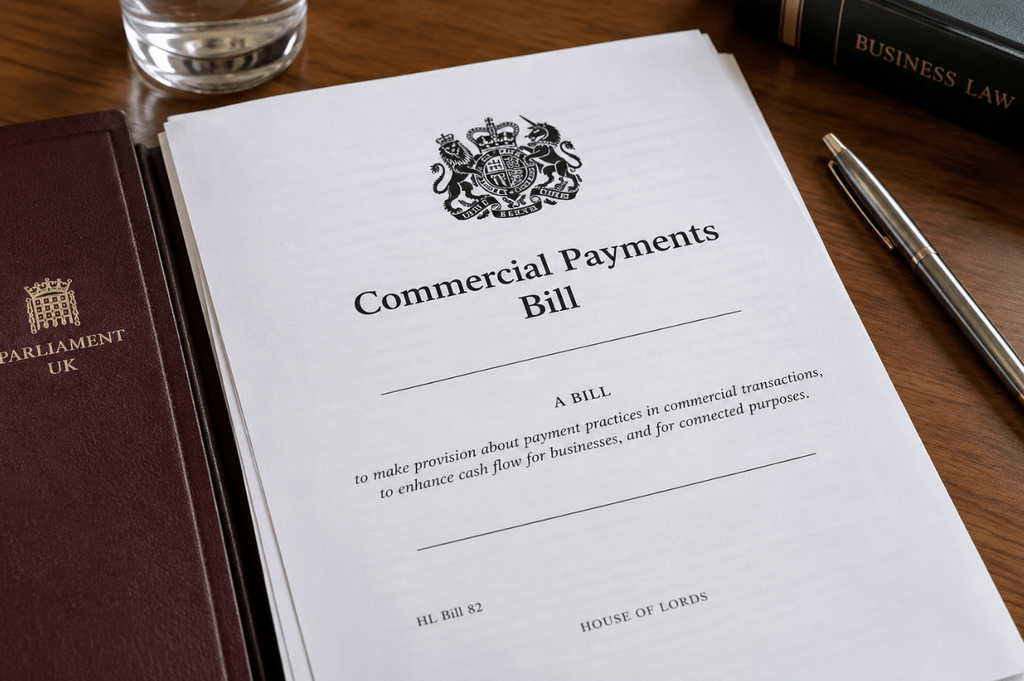
That framework is set to tighten significantly. The Commercial Payments Bill, currently before Parliament and progressing through the House of Lords, would impose a statutory cap on payment terms, make the right to statutory interest non-excludable, and give the Small Business Commissioner investigatory and enforcement powers. It is not yet law and its final shape may change, but the direction is clear, and businesses on both sides of the invoice should be modelling the impact on working capital now.
The habit that prevents it: specify payment periods, invoicing triggers, interest on late payment and a suspension right for non-payment. Then actually enforce them.
7. Varying contracts by convenience
Scope creeps, deadlines move, and someone agrees to it on a call. Where the contract contains a “no oral modification” clause, the Supreme Court held in Rock Advertising v MWB Business Exchange that the clause is effective, the informal variation simply does not take effect. Businesses can therefore find themselves performing to terms that are not contractually binding, and unable to charge for them.
The habit that prevents it: use a short written change control process, keep a single version of the current agreement, and make sure the people negotiating day to day know what they cannot vary informally.
The underlying point
Most contractual damage in smaller businesses is not caused by sophisticated legal risk. It is caused by drift – paper that no longer matches the business, signatures that were never obtained, and assumptions never tested. A periodic review of your standard terms, your top ten contracts by value and your IP chain will find more risk in an afternoon than a year of clause-level refinement.
This article is general information about the law of England and Wales as at August 2026. It is not legal advice and should not be relied upon as such. The Commercial Payments Bill referred to above has not yet been enacted and its provisions may change.