
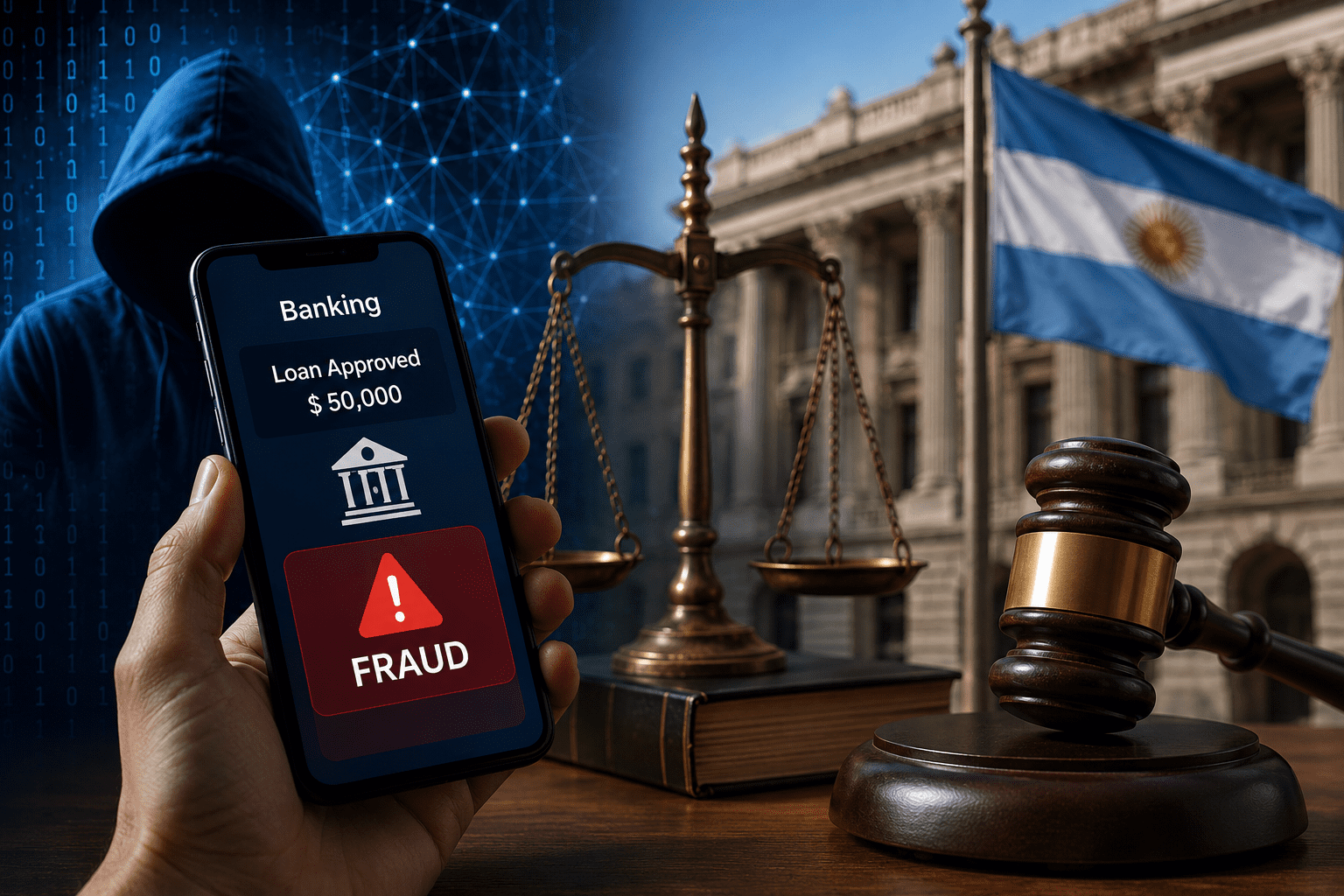
A recent decision issued by a court in Rosario, Province of Santa Fe, provides a noteworthy illustration of the increasingly demanding standards being applied to financial institutions in cases involving digital banking fraud.
The court declared null and void a series of loans obtained through a customer’s account without her knowledge or consent, ordered the removal of the corresponding indebtedness, and awarded damages against the bank.
Background
The claimant alleged that unknown third parties had gained access to her banking credentials and procured several loans through the bank’s digital platform. She maintained that she had neither requested nor authorised the transactions and contended that the bank had failed to implement adequate safeguards capable of detecting and preventing the fraudulent activity.
The bank argued that the transactions had been completed using the authentication procedures ordinarily required for remote banking operations and therefore should be presumed valid.
The Court’s Analysis
The court rejected the proposition that successful authentication, by itself, constitutes conclusive evidence of the customer’s informed consent.
In reasoning that may resonate beyond Argentina, the judgment emphasised that banks are professional providers of highly specialised services and consequently owe a heightened duty of care and security to their customers. The court observed that modern cyber-fraud techniques frequently enable unauthorised actors to circumvent ordinary authentication mechanisms, making it insufficient for a financial institution merely to demonstrate that the relevant credentials were used.
Particular weight was placed on the bank’s superior technical expertise and control over the digital infrastructure through which the transactions were executed. In the court’s view, this position entails a corresponding responsibility to adopt effective monitoring systems capable of identifying anomalous or suspicious activity before fraudulent transactions are consummated.
Consumer Protection Considerations
The decision reflects the influence of Argentina’s consumer protection framework, under which financial services are regarded as consumer transactions and providers are subject to stringent obligations concerning service safety and risk prevention.
The judgment is consistent with a broader judicial tendency to recognise the informational and technological asymmetry that exists between financial institutions and their customers. Where disputes concern systems designed, operated and controlled by the provider, courts have shown an increasing willingness to require banks to demonstrate the reliability of their security mechanisms rather than placing the burden entirely upon consumers.
Damages
In addition to declaring the loans unenforceable, the court awarded compensation for the losses and disruption caused by the fraudulent indebtedness.
The judgment acknowledges that financial fraud may generate harm extending beyond direct economic loss, including distress, uncertainty, reputational concerns and interference with an individual’s financial affairs.
Commentary
The decision forms part of a growing body of Argentine case law signalling that financial institutions may be expected to assume a more proactive role in preventing digital fraud.
For banks and fintech operators, the case highlights the litigation risks associated with relying exclusively upon formal authentication records when defending unauthorised transactions. For practitioners, it offers a useful example of how courts are adapting traditional principles of consent, duty of care and consumer protection to increasingly sophisticated forms of cyber-enabled financial crime.
As digital banking continues to expand across jurisdictions, questions concerning the allocation of fraud risk between consumers and financial institutions are likely to remain at the forefront of both regulatory and judicial developments.