
Review period: February–August 2026
1. Executive Summary
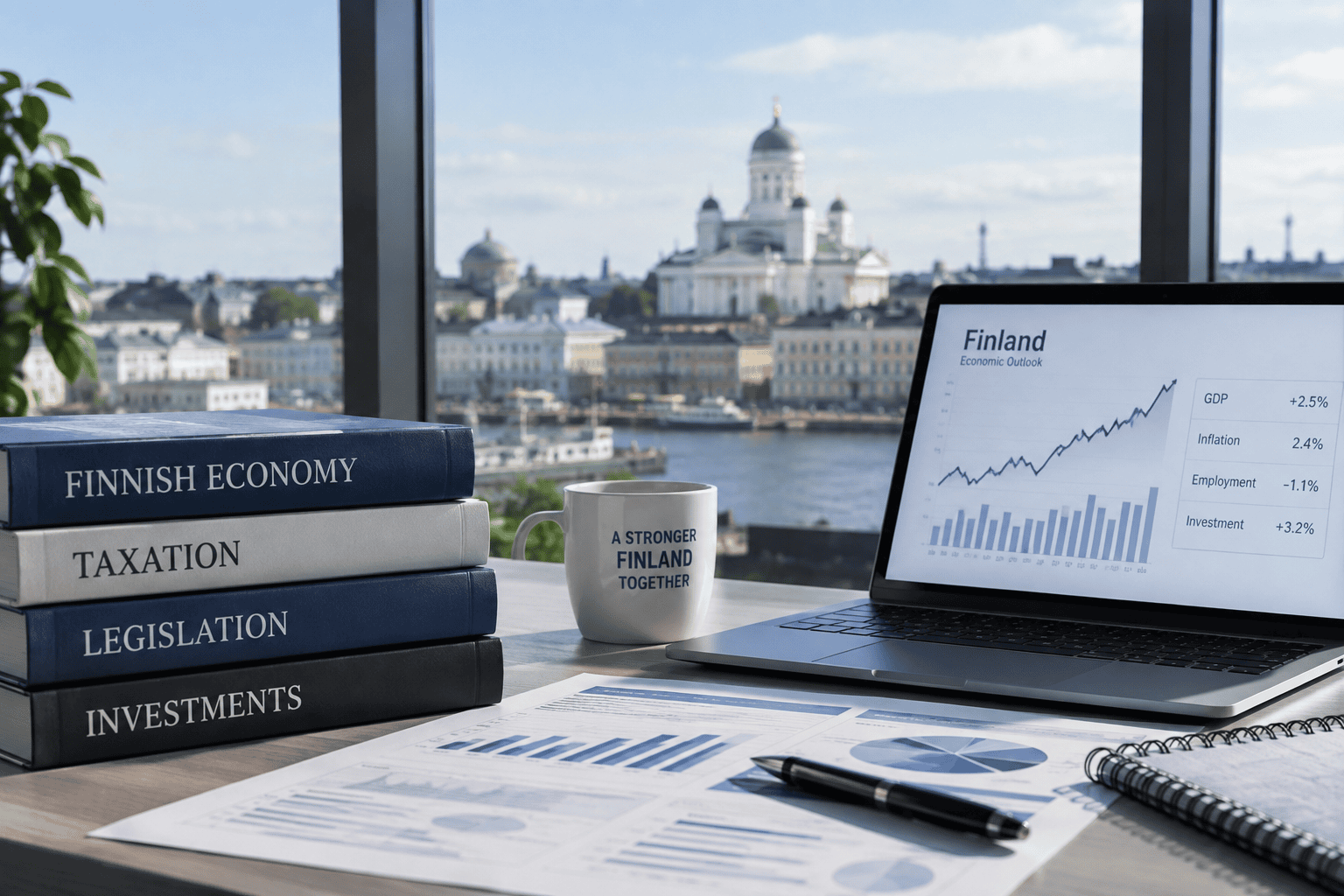
During 2026, Finland’s economy has gradually begun to recover from a prolonged period of weak growth. However, economic growth remains relatively slow and employment trends are still weak. According to Statistics Finland, Finland’s GDP grew by 0.9% in the first quarter of 2026 compared with the previous quarter. In the second quarter, preliminary figures showed another 0.9% quarterly increase. Compared with the same quarter of the previous year, GDP was 2.5% higher in the second quarter.
The main drivers of growth have been investment, exports, private consumption and public defence investment. In the first quarter, public investment increased by as much as 30.8%, mainly due to deliveries of defence equipment. Exports increased by 3.2% and private consumption by 0.9% compared with the previous quarter.
At the same time, Finland’s public finances remain under considerable pressure. The Government is continuing its fiscal consolidation measures while simultaneously seeking to reduce taxation on labour and businesses in order to stimulate economic growth.
2. Development of the Finnish Economy
2.1. Economic Growth Is Recovering
Finland’s economic growth for 2025 was revised to 0.8%, while previous estimates had been considerably lower. During the first quarter of 2026, GDP increased by 0.9% compared with the previous quarter.
The second quarter also showed positive growth. According to preliminary data published by Statistics Finland, GDP increased by 0.9% in April–June compared with the previous quarter and by 2.5% compared with the same period a year earlier.
This means that the Finnish economy is in a clearly better position than during the weakest growth period of 2024–2025. However, the current growth rate cannot yet be considered strong or fully stable.
2.2. Private Consumption
Household consumption has started to recover. During the first quarter, private consumption increased by 0.9%. Improvements in purchasing power, wage developments and lower interest rates are supporting consumer spending.
However, the household saving rate remains relatively high. This indicates that consumers are still cautious and that economic uncertainty continues to influence household behaviour.
2.3. Employment
The economic recovery has not yet translated into strong employment growth.
During the second quarter of 2026, the number of employed people was provisionally 1.1% lower than a year earlier, while the number of hours worked decreased by 1.4%.
This is one of the major challenges facing the Finnish economy: GDP is growing, but the recovery of the labour market is taking place more slowly.
2.4. Inflation
Inflation remains relatively controlled, although rising energy prices are creating new pressure.
The Bank of Finland estimated in June that Finnish inflation would rise to approximately 2.4% in 2026 due to higher energy costs. Inflation was forecast at 1.6% for 2027.
Inflation is therefore significantly more moderate than during the peak years of the energy crisis, but the risks associated with rising prices have not completely disappeared.
3. Government Economic Policy and Public Finances
During 2026, the Government’s main economic objectives have included:
- slowing down the growth of public debt;
- improving employment;
- reducing taxation on labour;
- increasing business investment;
- accelerating economic growth;
- strengthening research, development and innovation;
- increasing defence expenditure;
- improving Finland’s competitiveness.
However, the Government has to balance two conflicting objectives: supporting economic growth while simultaneously reducing public expenditure.
In April 2026, the Government announced that it would continue previously agreed expenditure cuts. At the same time, it considered tax reductions to be an important way of supporting domestic demand and economic recovery.
The draft budget for 2027 published in August includes substantial expenditure cuts. Total direct spending cuts amount to approximately EUR 4.8 billion. In addition, new measures aimed at limiting the increase in the debt-to-GDP ratio amount to almost EUR 1 billion.
4. Taxation in 2026
4.1. Value Added Tax
One of the important tax changes in 2026 was the reduction of the reduced VAT rate applicable to certain goods and services from 14% to 13.5%.
The change entered into force on 1 January 2026.
The purpose of the measure is to support consumer purchasing power and domestic demand.
Finland’s standard VAT rate remains 25.5%.
4.2. Taxation of Employment Income
In 2026, taxation on employment income was reduced, particularly for low- and middle-income earners.
According to the Government’s previous decisions, the overall reduction in labour taxation is approximately EUR 520 million in 2026. The Government has also set a target of reducing the highest marginal tax rate to approximately 52%.
The objective is to improve incentives to work and increase households’ disposable income.
4.3. Household Tax Credit
The household tax credit was increased for 2026.
The maximum amount increased from EUR 1,600 to EUR 2,100. For work purchased from a company, the deductible share increased from 35% to 40%, while for wages paid directly to an employee, the corresponding rate increased from 13% to 15%.
The objective is to encourage households to purchase services and reduce undeclared work.
4.4. Corporate Income Tax
In 2026, the standard corporate income tax rate for Finnish limited liability companies remains 20%.
However, an important future change has already been decided: according to the Government’s draft budget for 2027, the corporate income tax rate will be reduced from 20% to 18% in 2027.
The objective is to improve Finland’s competitiveness as a business and investment location.
5. Tax Digitalisation and Crypto Assets
One of the most important practical tax changes in 2026 concerns crypto assets.
From 2026, crypto-asset service providers must collect information about customers’ purchases, sales and transfers of crypto assets. The first annual reports to the Finnish Tax Administration will be submitted in 2027.
Finland’s system is in some respects broader than the international minimum requirements. Service providers must provide information that enables the Finnish Tax Administration to calculate capital gains and losses relating to crypto assets for people who are tax residents of Finland.
In practice, this means that tax monitoring of crypto assets will become significantly more effective.
6. Finland–Russia Tax Treaty
One of the important developments in international taxation during 2026 concerns the income tax treaty between Finland and Russia.
In June 2026, Finland announced that it would suspend the application of the Finland–Russia income tax treaty from 1 July 2026.
The background to the decision is that Russia had already unilaterally suspended the application of tax treaties with Finland and other countries that had imposed sanctions on Russia in 2023.
The change is particularly significant for individuals and companies that continue to have income, investments or other economic activities between Finland and Russia.
7. Investments
7.1. The Growing Importance of Investment
Investment is one of the most important sources of Finnish economic growth in 2026.
During the first quarter, private investment increased by 0.4% compared with the previous quarter. Public investment increased considerably more due to defence-related investment.
According to the Bank of Finland, growth is being supported particularly by non-residential investment, exports and the gradually recovering private consumption.
7.2. Defence Investment
The importance of defence spending and investment for the Finnish economy is increasing rapidly.
Deliveries related to the fighter aircraft procurement programme were already visible in Finland’s economic statistics during the first quarter of 2026.
The increase in defence investment is also supporting domestic industry, technology companies and subcontracting networks.
7.3. Clean Transition Investments
Finland is actively seeking to attract investment in:
- renewable energy;
- hydrogen;
- battery manufacturing;
- data centres;
- electricity grids;
- energy-intensive industries;
- the bioeconomy;
- processing of critical minerals.
Through the large clean-transition investment tax incentive introduced in 2025, tax credits totalling approximately EUR 2.3 billion were granted to 40 investment projects. In May 2026, preparations began for a new tax incentive for clean-transition investments.
7.4. Data Centres
Data centres are emerging as one of Finland’s potential new investment sectors.
Finland’s strengths include relatively clean electricity generation, a cold climate, a well-developed electricity grid and opportunities to integrate data centres into energy and district-heating systems.
In 2026, the Finnish Government has highlighted the importance of data centres to the developing energy system and economy.
8. Research, Technology and Innovation
Finland continues to increase its investment in research and development.
In 2026, government R&D funding is estimated at approximately EUR 3.17 billion, equivalent to around 1.07% of GDP.
Important growth sectors include:
- artificial intelligence;
- quantum computing;
- defence technology;
- health technology;
- biotechnology;
- advanced materials;
- hydrogen technology;
- clean energy;
- critical minerals.
In May 2026, Business Finland announced almost EUR 3 million in funding for two projects related to quantum computing.
In addition, EU IPCEI funding is being directed towards industrial investments in biotechnology as part of a EUR 156 million growth and employment package.
9. Changes to Employment Legislation
One of the major labour-law changes in 2026 concerns fixed-term employment contracts.
The changes entered into force on 1 June 2026. The objective is to make the use of fixed-term employment more flexible.
Under the new rules, fixed-term employment contracts can be used in certain circumstances without the same justification requirements as previously, although the total duration is limited to a maximum of one year.
The reform is part of the Government’s objective of increasing labour-market flexibility and making it easier, particularly for people entering the labour market, to obtain employment.
10. Platform Work and the Digital Labour Market
In July 2026, the Government published a draft law concerning platform work.
The purpose of the legislation is to implement the EU Platform Work Directive in Finland. The proposed legislation would apply to platform work performed in Finland regardless of where the digital platform itself is established.
The proposed legislation is expected to enter into force on 2 December 2026.
The reform may affect work performed through digital platforms in areas such as transportation, food delivery, freelancing and other platform-based services.
11. Construction and the Housing Market
The recovery of the construction sector remains one of the key issues for the Finnish economy.
Construction suffered heavily from high interest rates and weak demand during 2023–2025. In 2026, there are initial signs of improvement.
According to Statistics Finland, the cubic volume covered by building permits granted in June 2026 increased by 8% compared with the previous year.
The recovery of construction is important because the sector has extensive effects on employment, banks, construction materials, transportation and household wealth.
12. Internationalisation of Finnish Companies
At the beginning of 2026, an important organisational change took place at Business Finland.
A significant part of Finland’s activities related to exports and the internationalisation of Finnish companies abroad was transferred to the Ministry for Foreign Affairs and Finland’s network of diplomatic missions.
The objective is to strengthen the Team Finland network and better integrate exports, diplomacy and international market access.
13. The 2027 Budget – Important Upcoming Changes
The draft budget for 2027, published in August 2026, is one of the most important economic policy developments of recent months.
Its main elements include:
1. Reduction of the corporate income tax rate from 20% to 18% in 2027.
2. Significant reductions in public expenditure.
3. Increases in alcohol and tobacco taxes.
4. Measures aimed at improving employment.
5. Measures to limit the increase in public debt.
6. Support for economic growth and investment through taxation.
The Government is therefore simultaneously reducing corporate taxation while increasing certain consumption and excise taxes and cutting public expenditure.
14. Finland’s Main Economic Opportunities
Finland has several important potential sources of growth in the coming years.
1. Energy
Finland’s significant potential for renewable energy may attract energy-intensive investments.
2. Data Centres
The growing demand for computing capacity driven by artificial intelligence and cloud services is increasing demand for data centres.
3. Defence Industry
Changes in Europe’s security environment are increasing defence investment and creating opportunities for Finnish technology and manufacturing companies.
4. Hydrogen and Clean Industry
Finland is seeking to develop industrial activities based on hydrogen technology and clean energy.
5. Critical Minerals
Finland’s mining and metals industries may benefit from Europe’s efforts to reduce dependence on foreign supply chains.
6. Artificial Intelligence and Quantum Technology
Finland’s research and technology capabilities provide opportunities for the development of new high-tech companies.
15. Main Risks
Despite the economic recovery, Finland continues to face several major risks.
Public debt: The level of government and overall public-sector debt remains high, limiting the Government’s room for manoeuvre in economic policy.
Unemployment: Employment has not yet followed GDP growth.
International trade: Finland’s export-oriented economy is highly dependent on developments in European and global markets.
Energy: Higher energy prices could accelerate inflation.
Construction: The recovery of the construction sector remains uncertain.
Geopolitical situation: Russia’s war against Ukraine, international trade disputes and tensions between major powers affect Finland’s exports, investments and public expenditure.
16. Conclusion
During the period from February to August 2026, the overall picture of the Finnish economy has become cautiously positive.
The Finnish economy is growing again, exports and investment have recovered, and private consumption has begun to strengthen. At the same time, employment remains weak and public finances continue to face significant challenges.
The current core of the Government’s economic policy can be described as:
tax reductions + investment support + greater labour-market flexibility + public expenditure cuts.
The sectors with particularly strong long-term potential for Finland include clean energy, data centres, defence, hydrogen, critical minerals, artificial intelligence, quantum technology and other high-tech industries.
For companies, the planned reduction of the corporate income tax rate to 18% in 2027 is one of the most significant upcoming changes. For individuals, the most important developments include reductions in labour taxation, the increased household tax credit, VAT changes and significantly stronger tax monitoring of crypto assets.
Overall, Finland’s economy appears to be in a recovering but still vulnerable phase. The positive GDP figures in 2026 are an important sign of a potential turning point, but stronger and more sustainable growth will require improvements in investment, productivity and employment.